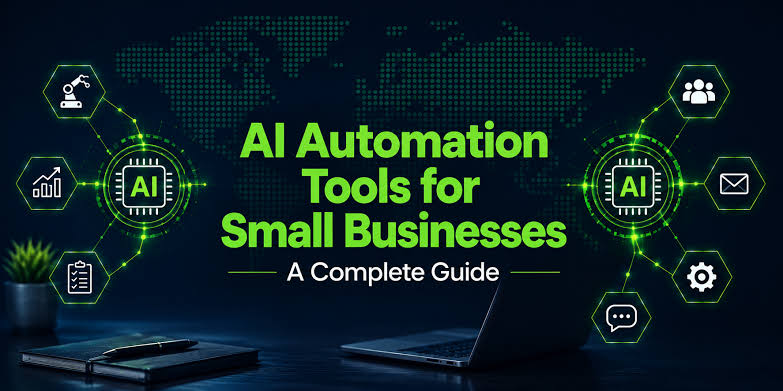
5 Best AI Automation Tools for Small Business (2026 Strategy)
For a growing small business, efficiency isn’t just a metric—it is your primary competitive advantage. When your team is small, every hour an employee spends manually copy-pasting lead data into a CRM, sorting through generic customer support emails, or manually typing up meeting action items is an hour stolen from high-value revenue production.
The promise of the modern corporate landscape isn’t about hiring more personnel; it is about building digital leverage.
The best AI automation tools for small business act as an invisible operations team running in the background. Instead of forcing you to jump across multiple disconnected applications, these advanced platforms integrate your tech stack, read unstructured data, qualify inbound prospects, and automatically execute complex task handoffs without human intervention.
We stress-tested the leading AI orchestration and automation tools on the market based on workflow reliability, integration depth, ease of use for non-technical teams, and real-world return on investment (ROI). Here is our definitive guide.
At a Glance: The Top AI Efficiency Stack Compared
If your team is currently buried under repetitive tasks and you need to deploy a secure, highly reliable operational backbone today, here is our top-level summary:
-
Best Overall for Simplicity: Zapier (with Copilot & Central) (The ultimate no-code app connector that uses natural language to build and run automated workflows).
-
Best for Complex Data Branching: Make (Outstanding for businesses that require visual, multi-step logic pathways at a highly cost-effective scale).
-
Best for Sales Intelligence: Clay (An exceptional data enrichment and outbound automation engine built explicitly for B2B sales teams).
-
Best for Internal Knowledge: Notion AI (The gold standard for automating internal standard operating procedures and company documentation).
The Integration Gap: Why Standard Apps Drag Down Small Teams
The single greatest mistake small business owners make is assuming that buying individual “AI features” inside their current software is enough. Your CRM might have an AI email writer, and your project tool might have an AI task text generator, but if those platforms cannot talk to each other automatically, you still suffer from severe operational fragmentation.
If your information handoff flow is manual, your team runs a fractured, multi-tab routine:
-
Tab 1: Manually exporting new leads from a website form.
-
Tab 2: Reviewing social media accounts to research the prospect’s background.
-
Tab 3: Typing up custom entry notes inside a separate CRM portal.
-
Tab 4: Writing a personalized greeting email from a private inbox.
True AI automation moves your business into an event-driven workflow framework. A prospective client fills out a website form, which instantly triggers an AI agent to research their business profile, enrich their CRM record, match them to an internal account executive, and deploy a hyper-tailored introductory proposal—running completely in the background in under 60 seconds.
In-Depth Reviews: The 5 Best AI Automation Tools for Small Business
1. Zapier (with Copilot & Central) – Best Overall AI Workflow Automation
Zapier remains the definitive backbone of small business automation. While it historically required meticulous manual mapping, its deep integrations with natural language engines allow non-technical teams to speak automation into existence.
-
Who It Is Best For: Small business owners, boutique agencies, and solo operators who want to eliminate repetitive app-to-app data entries with zero coding.
-
Main Strengths: Unmatched ecosystem depth, connecting seamlessly across more than 9,000 distinct apps. Their AI Copilot feature allows you to build workflows using plain English prompts (e.g., “When a new lead hits my web form, summarize their company using AI and ping the sales channel on Slack”), handling the backend testing automatically.
-
Important Limitations: Monthly subscription costs scale upward rapidly if your business processes very high volumes of multi-step automations.
-
Pricing Context: A highly capable free baseline tier allows for simple single-trigger automations. Premium starter tiers scale outward comfortably based on task execution volumes.
2. Make – Best for Branching Data & Visual Operations Pipelines
For businesses that find Zapier’s vertical layouts too restrictive, Make (formerly Integromat) provides an incredibly powerful, unrestricted visual drag-and-drop workspace canvas.
-
Who It Is Best For: E-commerce brands, operations teams, and scaling agencies managing complex multi-platform logistical workflows.
-
Main Strengths: Exceptional structural data control. Make treats automation like a visual mind map, allowing you to build highly complex scenarios that route, split, filter, and recombine data paths based on intricate conditional rules. It is significantly more cost-effective than competitors when running thousands of high-volume background tasks.
-
Important Limitations: The visual node editor carries a slightly steeper technical onboarding curve compared to plain-text prompt platforms.
-
Pricing Context: Generous free plan providing baseline monthly operations allocations. Paid scaling plans are highly budget-friendly for heavy automated data cycles.
3. Clay – Best AI Automation for Lead Research & Outreach Personalization
If your small business relies heavily on outbound business-to-business (B2B) sales, cold emailing, or account-based marketing, Clay is an absolute game-changer.
-
Who It Is Best For: Sales teams, B2B founders, and marketing departments looking to replace manual virtual assistant research with deep AI data harvesting.
-
Main Strengths: Clay acts like a spreadsheet connected to 50+ premium data enrichment providers simultaneously. You input a list of prospect websites, and the system automatically extracts verified phone numbers, recent executive hire profiles, fundraising data, and social media posts. Its built-in AI then reads that aggregated data to draft context-specific opening lines for your sales pitches.
-
Important Limitations: It is built explicitly as a specialized data enrichment engine for go-to-market teams; it is not a general customer support help desk manager.
-
Pricing Context: Tiered credit packages structured around active prospect enrichment profiles.
4. Notion AI – Best for Automating Standard Operating Procedures (SOPs)
Most business efficiency is lost not because people are lazy, but because internal company data is completely unorganized. Notion AI addresses this internal bottleneck by acting as your searchable team mind.
-
Who It Is Best For: Teams of 3 to 30 people managing remote employees who need to centralize internal knowledge bases, training logs, and process guides.
-
Main Strengths: Exceptional content restructuring. Notion AI can review a long, unorganized audio transcript of an internal training call and automatically convert it into a beautifully formatted, clear Standard Operating Procedure (SOP) with step-by-step checklists. It lets employees query your internal database directly via a workspace chat to find hidden company policies instantly.
-
Important Limitations: It lacks any native out-of-the-box browser web form selectors or invoice credit card integrations.
-
Pricing Context: Integrates directly as a scalable add-on feature inside existing Notion team workspaces.
5. Fireflies.ai – Best for Meeting Intelligence & Insight Extraction
Client meetings and internal sync calls consume immense mental bandwidth. Fireflies.ai stops that structural time drain by converting conversations into searchable data.
-
Who It Is Best For: Consulting groups, service agencies, and client-heavy professional service businesses.
-
Main Strengths: Fireflies automatically connects to your digital calendars, silently joins your video conference links (Zoom, Google Meet, Webex), and builds highly accurate written transcripts. Rather than forcing you to review long audio files, it outputs an interactive summary mapping exact metrics, customer sentiment tags, competitor mentions, and direct follow-up allocations.
-
Important Limitations: Transcribing highly technical industry jargon or heavy accents occasionally demands minor manual correction.
-
Pricing Context: Functional free basic options with scalable premium configurations for full workspace sharing.
Buying Guide: How to Engineer a High-ROI Small Business AI Stack
To prevent subscription waste and build an ecosystem that drives real profit, map your roll-out plan using this framework:
-
Roll Out in Progressive Stages: Do not attempt to integrate five separate automated platforms simultaneously. Start by fixing your routing layer first using tool connectors (Zapier or Make). Once your basic application integrations run smoothly, implement outbound optimization (Clay) or document organization tools (Notion AI).
-
Audit Your Native Tech Footprint: Before looking at custom software tools, look closely at your primary corporate platform workspace. If your team lives entirely inside Google Workspace applications, leverage Google Gemini tools. If your daily records rely fully on Word and Excel environments, look first at Microsoft 365 Copilot to leverage built-in automation shortcuts.
-
Enforce Strict Data Portability: Always select platforms that offer clean, unencrypted data extraction rules. Your client interaction logs, sales lead intelligence, and internal documentation histories are highly sensitive core assets that you must own outright.
The Automation Boundary: Preserving the Human Touch
As a veteran professional business researcher, I must deliver an upfront reality check: AI automation is engineered to build structural leverage, not to completely insulate you from your audience.
In the current market, small business customers value personalization more than ever before. If you let an automated engine run your client support responses with 100% autonomy, or use unedited AI tools to blast out hundreds of generic outreach emails, your brand perception will plummet.
The Golden Ratio: Use tools like Zapier or Make to handle the heavy lifting of data organization—the copying of records, the automatic routing of support tickets, and the generation of internal analytics briefs. But ensure that final client-facing communications, high-level relationship strategies, and delicate account closings preserve a genuine human touch.
Final Verdict: Which Automation Platform Wins the Day?
-
If your primary priority is building fast, effortless automated linkages between multiple business apps using plain-text language, choose Zapier.
-
If your operational workflows demand highly detailed visual scenarios that route data down multiple branching paths at a lower cost, choose Make.
-
If you manage a business-to-business agency or consultancy where deep outbound lead enrichment determines your pipeline velocity, choose Clay.
Frequently Asked Questions (FAQ)
1. Will implementing AI automation require hiring an expensive developer?
No. Platforms like Zapier and Make are explicitly designed as no-code graphical environments. Non-technical business owners can configure comprehensive, multi-step cross-app workflows using simple drag-and-drop mechanics or interactive natural language builder tools.
2. Is it safe to process sensitive financial and customer logs through AI connectors?
Top-tier automated SaaS platforms enforce strict enterprise-grade data security parameters, utilizing secure end-to-end encryption hooks. However, to protect your company’s data privacy, ensure that your internal settings block public language models from using your proprietary customer records for training purposes.
3. How long does it typically take to set up a clean business workflow?
A basic trigger-action sequence (like automated lead capture or Slack metric pings) can be fully deployed and tested in under 15 minutes. Advanced visual scenarios containing multiple branching rules or deep lead data enrichment setups generally require 2 to 5 hours of dedicated optimization.
4. What is the difference between an AI model and an automation connector?
An AI model (like ChatGPT or Claude) acts as the “brain,” analyzing text strings, running logical assessments, and drafting content. An automation connector (like Zapier or Make) acts as the “nervous system,” physically moving data parameters across different software platforms to execute tasks automatically.