5 Best No-Code Automation Software for Small Business (2026)
For a lean, fast-moving small business, operational drag is the silent killer of growth. When your headcount is limited, every hour an employee spends manually downloading CSVs, copy-pasting customer details from an email into a CRM, or shuffling files between storage folders is an hour stolen from closing deals and serving clients.
The baseline expectation for a modern business isn’t just working harder—it’s about creating structural leverage.
The best no-code automation software for small business functions as a digital nervous system running quietly in the background. By removing the need for a professional software developer, these visual platforms allow anyone on your team to link your software stack together, pass information across tools, and build intelligent workflows that trigger automatically.
We independently evaluated the top no-code automation engines on the market based on tool reliability, integration library depth, ease of use, and overall return on investment (ROI) for growing teams. Here is our definitive guide.
At a Glance: The Top No-Code Automation Frameworks Compared
If your team is currently overwhelmed by administrative tasks and you want to build an automated workflow right now, here is our top-level editorial summary:
-
Best Overall for Mass Integration: Zapier (The undisputed market leader for fast, trigger-action connections across thousands of SaaS apps).
-
Best for Visual Power Users: Make (The strongest visual mind-map style canvas, offering deep data manipulation at a fraction of the cost).
-
Best for Microsoft Environments: Microsoft Power Automate (The default choice for small businesses heavily anchored inside the Microsoft 365 ecosystem).
-
Best for Data Ownership: n8n (An incredible open-source, fair-code option for privacy-conscious teams that prefer to self-host their data).
The App Fatigue Trap: Why Disconnected Software Slows You Down
The single biggest mistake small business owners make is assuming that buying specialized tools is enough. Your accounting software might be elite, your CRM might be modern, and your project board might be beautiful—but if information requires a human to manually carry it from one tab to another, your efficiency collapses.
Without automated handoffs, your daily sales cycle introduces severe operational fragmentation:
-
Step 1: A new lead triggers an alert in your website forms inbox.
-
Step 2: An employee logs in to a separate CRM to manually type up the client file.
-
Step 3: The team manually opens an email provider to copy-paste a generic greeting.
-
Step 4: A calendar link is built manually to request a consultation.
True no-code business process automation shifts your workflow into an event-driven framework. The second a customer submits a form, a pre-built pathway automatically logs the contact into the CRM, queries an AI module to summarize their business size, pings the designated account executive on Slack, and fires off a personalized booking link—executing seamlessly in under 10 seconds.
In-Depth Reviews: The 5 Best No-Code Automation Software platforms
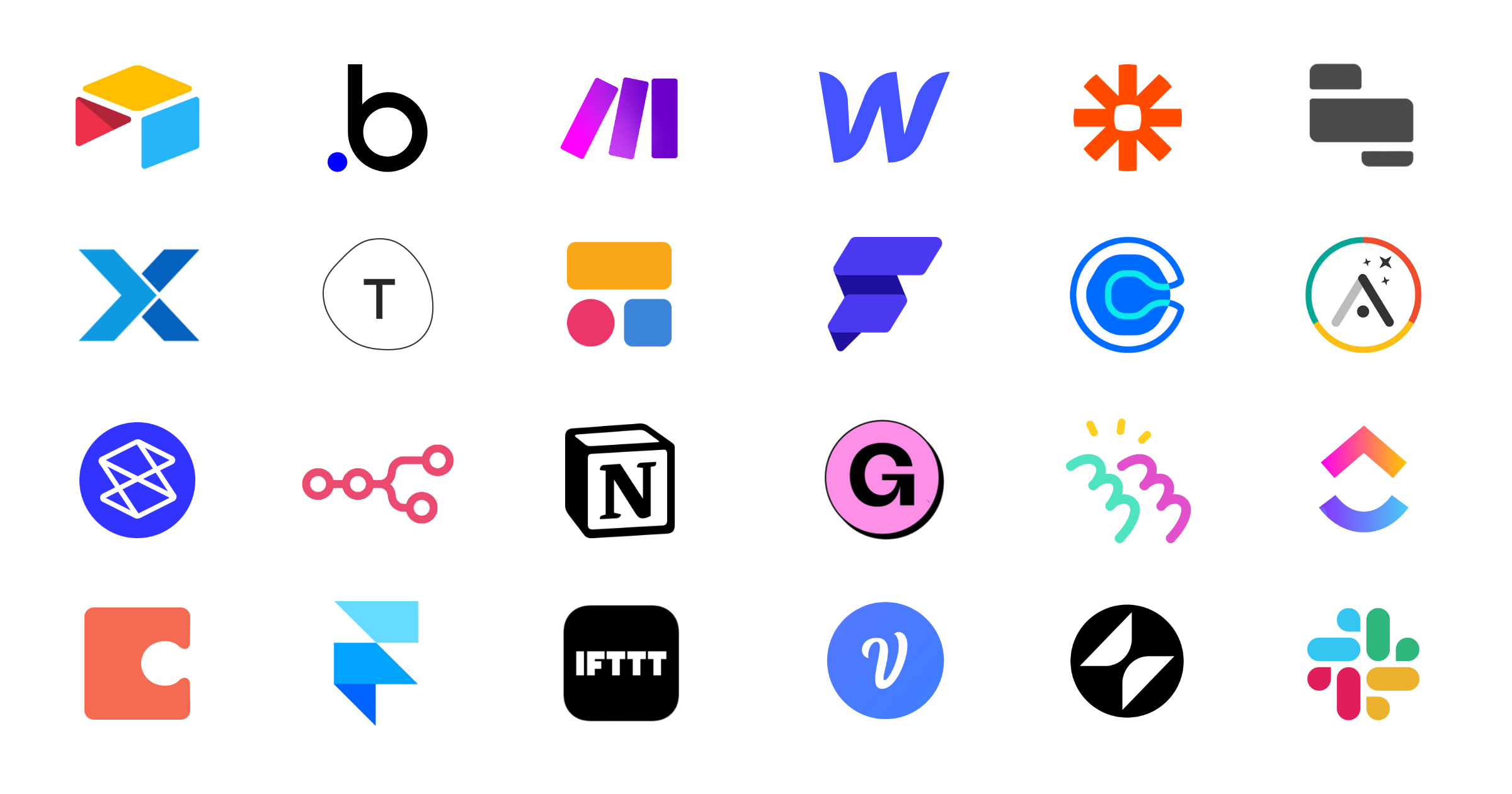
1. Zapier – Best Overall for Fast, Wide-Reach Integration
Zapier popularized the modern “connect any app to any app” ecosystem and remains the most recognizable no-code automation platform globally. Its entire value proposition centers on speed and reducing barriers to entry.
-
Who It Is Best For: Non-technical small business owners and marketing teams who need to spin up rapid, event-driven integrations without dealing with code syntax or APIs.
-
Main Strengths: An unmatched library of 7,000+ native application connectors. Its workspace layout is linear and highly intuitive, guiding you through a simple “If This Happens, Do That” builder loop. It now features excellent natural language triggers, letting you type out your automation intent in plain English to build paths automatically.
-
Important Limitations: Monthly subscription costs scale upward quickly if your business processes highly complex, multi-step tasks at a large volume.
-
Pricing Context: Highly functional free tier handles 100 simple single-step tasks per month. Paid Professional tiers unlock premium app hooks starting around $20 per month.
2. Make – Best for Visual Scenarios & Complex Data Transformations
For businesses that find linear checklist tools too restrictive, Make (formerly Integromat) provides an open, visual flowchart-style canvas that lets you map out data paths creatively.
-
Who It Is Best For: Operations managers, analysts, and tech-savvy founders who require advanced branching logic, filters, and loops.
-
Main Strengths: Make treats automation like a visual mind map. It allows you to build extensive multi-directional branches where a single trigger can send customized data packets to entirely separate apps based on strict internal filters. Crucially, its operation costs are dramatically lower than Zapier’s for heavy background data cycles.
-
Important Limitations: The visual schema mapping tools introduce a slightly steeper learning curve for absolute tech beginners.
-
Pricing Context: A highly generous free tier covers 1,000 monthly operations allocations. Scaling paid plans start comfortably at roughly $9 to $29 per month.
3. Microsoft Power Automate – Best for Windows & Microsoft 365 Shops
If your small business runs entirely inside the Microsoft corporate framework—relying heavily on Outlook, Excel, SharePoint, and Teams—Power Automate is your default destination.
-
Who It Is Best For: Established professional services, local firms, and B2B operators anchored tightly within the Microsoft 365 software environment.
-
Main Strengths: Flawless native compliance and security framework integration. It handles internal database routing—like instantly parsing incoming Outlook attachments and filing them to structured SharePoint folders—with zero security friction. It also provides robust desktop RPA (Robotic Process Automation) modules to automate legacy desktop apps.
-
Important Limitations: The platform interface can feel clinical, corporate, and overly technical if your business relies on modern consumer tools like Slack, Notion, or Figma.
-
Pricing Context: Frequently bundled as a native capability inside existing commercial Microsoft 365 licensing tracks, with standalone premium additions available.
4. n8n – Best for Privacy-Conscious Teams & Data Autonomy
For small businesses handling highly sensitive client parameters—such as legal firms, medical clinics, or financial consultants—n8n provides absolute backend control.
-
Who It Is Best For: Small teams with basic technical literacy who refuse to lock their customer records inside third-party vendor databases.
-
Main Strengths: It offers a highly unique, fair-code architecture that allows you to self-host the entire automation engine on your own secure private servers completely free. The visual canvas combines node-based simplicity with the option to inject raw JavaScript blocks whenever you require deep, custom logic control.
-
Important Limitations: Managing a self-hosted server deployment introduces minor ongoing structural maintenance responsibilities compared to pure cloud SaaS apps.
-
Pricing Context: Self-hosted base usage is completely free. Their fully managed official cloud hosting tiers scale out predictably based on workflow volume requirements.
5. Airtable Automations – Best When the Database Drives the Process
If you don’t want to use an external standalone middleware app, Airtable’s native automation builder allows you to configure rules directly inside your primary data rows.
-
Who It Is Best For: Project groups, content production teams, and small agencies whose daily work centers on managing a single central source of record truth.
-
Main Strengths: Extreme low-friction usability. Because your automations live right inside your spreadsheet-database tables, you can trigger actions based on direct cell changes—for example, shifting a custom status dropdown label to “Approved” can instantly fire an automated text alert to an external client via email or Slack.
-
Important Limitations: The connection catalog is restricted to major popular apps; it lacks the deep long-tail variety found in open connectors.
-
Pricing Context: Included as a built-in feature set across Airtable’s standard core subscription tiers, starting at ~$20 per seat per month.
Buying Guide: How to Blueprint a High-ROI Automation Flow
To safeguard your small business against software sprawl and ensure your automated pathways actually save billable hours, map your roll-out plan using these core strategic steps:
-
Audit for Volume, Not Emotion: Do not build a complex automation just because a process sounds cool. Map out your real-world team routine. Look for high-frequency tasks: data entries that happen 30+ times a week are prime candidates for no-code tools. Automating a task that you only perform once a month is rarely worth the configuration time.
-
Separate Trigger and Action Payload Layers: When setting up paths inside tools like Zapier or Make, keep your building blocks modular. Ensure that a change in one operational system (like swapping your email provider from Gmail to Outlook) only requires altering a single action block node, rather than forcing you to rebuild your entire logic scenario from scratch.
-
Target the 80% Win Rate: Do not try to automate 100% of an incredibly nuanced workflow that involves high-level human context or emotional exceptions. Build your automated pathways to handle the standard 80% baseline footprint of the process (the data routing, notification alerts, and basic logging), and leave a clean “Human-in-the-Loop” notification block to step in for the final review.
The Creative Boundary: Maintaining Personal Business Context
As an independent business analyst, I must deliver a critical warning regarding excessive systems engineering: No-code tools excel at moving fields between systems, but they carry zero native understanding of your actual business context.
An automated scenario inside a tool like Zapier or Make is completely rule-bound. It functions as a digital pipeline that processes text string inputs flawlessly, but it cannot evaluate customer tone, read subtle brand subtext, or make ethical choices.
The Professional Rule: Use no-code platforms to automate the clinical logistics of your small business—the background data copying, calendar checking, task creating, and notification routing. But preserve your real human time for strategic, high-value operations: custom customer face-to-face strategies, complex deal closings, and personalized client-facing creative problem solving.
Final Verdict: Which No-Code Software Wins Your Business?
-
If your primary objective is spinning up rapid, event-driven connections across an expansive library of external apps with absolute minimal setup friction, choose Zapier.
-
If your operational workflows demand complex logic pathways with heavy, high-volume data manipulations at the lowest per-operation cost, choose Make.
-
If your small business operates entirely inside localized privacy frameworks and requires absolute server-level data autonomy, choose n8n.
Frequently Asked Questions (FAQ)
1. What is the difference between no-code and low-code software?
No-code software platforms (like Zapier) rely entirely on graphical user interfaces, drag-and-drop actions, and visual prompts, allowing non-technical users to build tools without writing code. Low-code platforms (like n8n) use visual builders but include open code canvas boxes where developers can write custom snippets of JavaScript or Python to handle complex data alterations.
2. Can using automated tools break my primary business data?
If you configure an automation incorrectly—such as setting up a continuous data loop that updates the same record back and forth indefinitely—you can accidentally create data formatting errors or deplete your monthly platform credit allocations rapidly. Always run your workflows inside the software’s built-in “Test Mode” using mock data before turning the pathway live.
3. How long does a standard automation setup take to build?
A straightforward trigger-action sequence (like automatically copying a new HubSpot lead profile over to a specific Slack channel) can be fully constructed and deployed in under 10 to 15 minutes. Advanced scenarios featuring intricate multi-app database branches typically require 2 to 4 hours of design planning.
4. What happens if a connected software app updates its system parameters?
Leading cloud automation suites manage active developer relationships directly. When a major software company updates its underlying API infrastructure, platforms like Zapier or Make update their native building blocks automatically in the background, ensuring your active integration scenarios remain stable without requiring ongoing manual code repairs.