5 Best Cybersecurity Certifications for Beginners (2026 Guide)
The modern threat landscape is shifting at an unprecedented pace. With the rise of AI-generated cyberattacks, cloud system vulnerabilities, and continuous corporate security breaches, organizations have realized that defensive security is an absolute business necessity. As a result, companies across every primary sector are prioritizing threat readiness over traditional academic degrees.
If you are looking to execute a major career pivot out of non-tech roles, or transition from basic IT support into a specialized, higher salary tier, cybersecurity provides an incredibly high-value avenue.
However, searching for introductory training creates a major roadblock. The industry is saturated with unverified “cyber badges” that corporate recruiters completely ignore.
To successfully break through HR screening filters, you need a globally recognized cybersecurity certification for beginners. You need a credential track that assumes zero professional security background, validates foundational defensive skills, and matches the strict framework requirements that top-tier employers actively prioritize.
We independently evaluated the leading beginner-friendly security certifications on the market based on recruitment keyword demand, DoD 8140 compliance, entry-level cost, and real career return on investment (ROI). Here is our definitive guide.
At a Glance: The Top Entry-Level Security Credentials Compared
If you are actively studying to pivot your career and want to choose a highly credible resume anchor today, here is our top-level editorial summary:
-
Best Overall for Finding a Job: CompTIA Security+ (The undisputed industry standard that appears in roughly 70% of entry-level security job postings).
-
Best for Absolute Tech Beginners: Google Cybersecurity Professional Certificate (The premier budget-friendly, hands-on path for career changers with zero prior IT experience).
-
Best High-Authority Free Alternative: ISC2 Certified in Cybersecurity (CC) (Outstanding if you want a zero-cost learning entry point issued by the world’s premier security leadership association).
-
Best for Core Networking Fundamentals: Cisco Certified Network Associate (CCNA) (The definitive technical benchmark for mastering the plumbing of enterprise networks before layering on defensive security).
The Reskilling Strategy: Why Broad Defensive Concepts Matter Most
The single biggest mistake cybersecurity beginners make is chasing highly specialized, aggressive “ethical hacking” or penetration testing certifications on day one. While offensive security sounds exciting, the overwhelming majority of open, entry-level jobs sit firmly within defensive security operations (Blue Team).
Before attempting to hack complex corporate systems, you must understand how to configure and defend them. To build a resilient professional application profile, your foundational training must cleanly map across these core security architecture layers:
┌────────────────────────────────────────────────────────┐
│               1. Infrastructure Layer                  │
│     (Understanding IP connectivity & network access)   │
└────────────────────────┬───────────────────────────────┘
                         │
                         ▼
┌────────────────────────────────────────────────────────┐
│                  2. Defensive Layer                    │
│   (Configuring firewalls, access controls, & SIEMs)    │
└────────────────────────┬───────────────────────────────┘
                         │
                         ▼
┌────────────────────────────────────────────────────────┐
│             3. Threat Identification Layer             │
│   (Running vulnerability scans & auditing risk drops)  │
└────────────────────────┬───────────────────────────────┘
                         │
                         ▼
┌────────────────────────────────────────────────────────┐
│               4. Incident Response Layer               │
│  (Following strict corporate frameworks to clear cuts)  │
└────────────────────────────────────────────────────────┘
A high-value certification verifies your competence across this entire operational ecosystem, ensuring you carry the exact language and skills demanded inside modern Security Operations Centers (SOCs).
In-Depth Reviews: The 5 Best Cybersecurity Certifications for Beginners
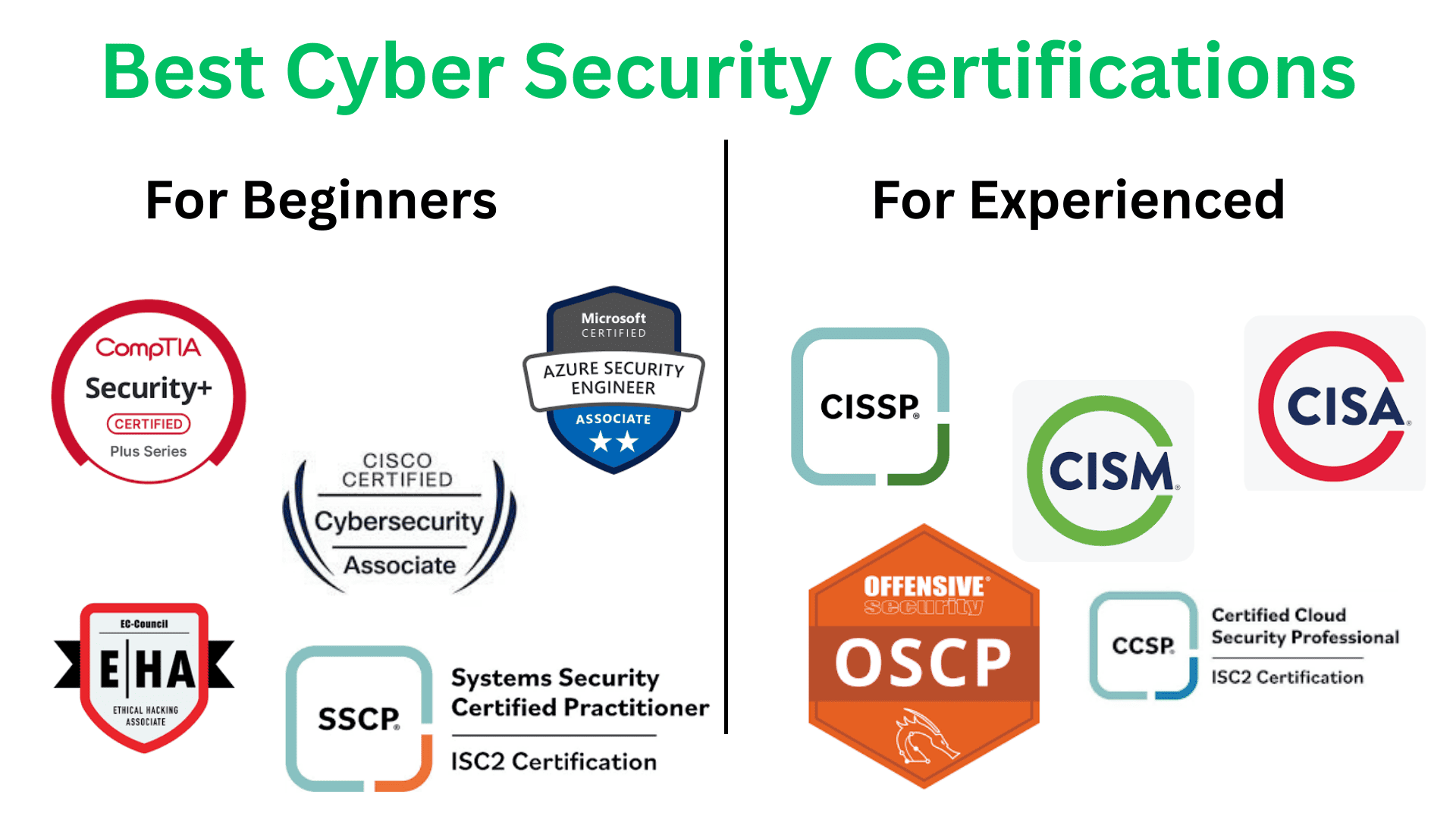
1. CompTIA Security+ (SY0-701) – Best Overall for Marketplace Demand
CompTIA Security+ is universally recognized as the default starting credential across the entire cybersecurity sector. It functions as the ultimate baseline filter for human resource departments globally.
-
Who It Is Best For: Career switchers, help desk analysts, and junior administrators who need a verified, highly versatile credential to clear formal corporate hiring loops.
-
Main Strengths: Unmatched marketplace momentum. It appears in the vast majority of entry-level security postings and satisfies strict United States DoD 8140/8570 compliance metrics, making it mandatory for government-adjacent or defense contractor roles. The syllabus covers core architectural layers beautifully: threat detection, risk management frameworks, baseline cryptography, and cloud infrastructure security.
-
Important Limitations: The exam voucher costs a standard flat scale of roughly $404 to $425, which can represent a noticeable upfront investment for independent students.
-
Pricing Context: Single exam voucher scales apply globally, with modular training bundles available separately.
2. Google Cybersecurity Professional Certificate – Best for Career Changers on a Budget
If you want a highly supportive, project-based onboarding experience that assumes zero prior coding or corporate IT administration background, Google’s certificate program is an exceptional option.
-
Who It Is Best For: Absolute beginners looking to break into technology fields who prefer hands-on lab projects over dry, textbook theory.
-
Main Strengths: Elite practical training velocity. Instead of simply training you to select multiple-choice answers, Google teaches you the core practical tools used by day-to-day SOC analysts: Linux operating lines, SQL database queries, basic Python automation scripts, and SIEM security monitoring tools (like Chronicle). Completing the track also unlocks a valuable 30% discount voucher code for the CompTIA Security+ exam.
-
Important Limitations: While excellent for building skills, the standalone certificate carries less traditional authority with experienced enterprise security directors than a proctored, closed-book exam.
-
Pricing Context: Highly affordable month-to-month subscription structures via Coursera (approx. $49/month).
3. ISC2 Certified in Cybersecurity (CC) – Best Free Elite Entry Point
Administered by the world’s premier cybersecurity leadership organization (the same body behind the elite, advanced CISSP certification), the ISC2 CC track provides instant industry credibility.
-
Who It Is Best For: Complete beginners and students who want a highly polished, globally recognized professional credential on a strict $0 learning budget.
-
Main Strengths: Exceptional cost efficiency. As part of their global initiative to close the workforce talent gap, ISC2 currently provides the foundational training courses and the initial official exam attempt completely free for new members. The syllabus provides clear training on security principles, network access control protocols, and incident handling workflows.
-
Important Limitations: To keep the certification active post-exam, you must pay a modest, annual maintenance fee (AMF) of approximately $50.
-
Pricing Context: Free initial exam voucher blocks upon registering as an official ISC2 Candidate.
4. Cisco Certified Network Associate (CCNA) – Best for Mastering the Network Layer
Many beginners make the mistake of studying advanced security tools without understanding how data physically travels across a wire. The Cisco CCNA completely fixes this knowledge bottleneck.
-
Who It Is Best For: Aspiring network security engineers, junior security analysts, and technical operators who want deep, structural infrastructure fluency.
-
Main Strengths: Exceptional long-term technical value. The CCNA is the undisputed gold standard for enterprise routing and switching diagnostics. It explicitly validates your real-world capability to configure, manage, and secure routers and switches, understand IP connectivity logic, and audit enterprise firewall rules smoothly.
-
Important Limitations: The exam focus centers heavily on Cisco system architectures, making it dense and highly technical for casual non-coding beginners.
-
Pricing Context: Standard single proctored examination voucher fee sits around $300.
5. CompTIA Network+ (N10-009) – Best Vendor-Neutral Network Foundation
If you want to master the foundational plumbing of corporate networks without locking yourself into a single equipment manufacturer’s proprietary language, the CompTIA Network+ is the standard alternative.
-
Who It Is Best For: Career changers who want a smooth, vendor-neutral baseline to support their Security+ preparation.
-
Main Strengths: Universal structural concepts. This certification tests you on elements that remain stable across the entire IT landscape: the Open Systems Interconnection (OSI) layer framework, standard network topologies, secure routing protocols, cloud infrastructure concepts, and basic wireless network defense setups.
-
Important Limitations: It is an auxiliary foundational IT credential rather than a dedicated cybersecurity analysis tool, meaning it should be paired with a security-specific cert.
-
Pricing Context: Standard single-payment proctored exam fee scaling globally.
Buying Guide: How to Align Your Training Choice with Reality
To protect your learning hours and ensure your chosen curriculum clears entry-level filters, evaluate your roadmap against this framework:
-
Separate Skills Platforms from Exam Badges: Platforms like TryHackMe or Hack The Box are spectacular for hands-on, practical lab exercises. However, HR software filters actively query text profiles for formalized proctored acronyms like Security+ or CCNA. Use skills platforms to pass your practical technical screens, but secure an industry-recognized badge to clear the initial application gate.
-
Verify Regional Employer Demand: Before paying for an account, run a search on major regional job directories. If your target corporate geography lists CompTIA Security+ in 80% of its help desk or junior SOC technician postings, bypass alternative introductory tool tracks and target the market standard directly.
-
Leverage Continuous Labs: Cybersecurity is a highly active technical discipline; memorizing textual definition files will not save your network during a live incident. Prioritize learning paths that mandate interactive simulation loops, firewalls configurations, and packet capture logs to verify execution capacity.
The Strategic Balance: The Logic Layer Protects the Margin
As a veteran professional business systems analyst and cybersecurity coach, I must deliver an upfront reality check: A security certification is a powerful gate-opener, but your ability to translate technical anomalies into corporate risk parameters is what wins the job.
The single biggest mistake career changers make when entering technical panels is speaking exclusively in loose developer text descriptions. Senior security directors do not just care if a script captures a malware file; they care about business resilience and risk alignment.
When you construct your project portfolios or answer behavioral panel interview loops, frame your insights like an expert corporate brief. Explicitly connect technical events to business impacts: How does automating this firewall log aggregation shield the business from regulatory non-compliance? How much capital loss does blocking this specific vector prevent? How does this setup minimize corporate down-time?
Mastering that line of business logic is what truly establishes your professional authority and transforms you into an indispensable asset for your firm.
Final Verdict: Which Beginner Security Cert Wins Your Time?
-
If you want the absolute ultimate, most widely recognized vendor-neutral entry filter that appears on the vast majority of modern corporate and government job descriptions, choose CompTIA Security+.
-
If you are a complete career changer with zero technical IT experience who requires a highly guided, budget-friendly Python-and-Linux project framework, choose the Google Cybersecurity Certificate.
-
If you want an elite, high-authority entry credential backed by the industry’s premier global security association completely free, choose the ISC2 Certified in Cybersecurity.
Frequently Asked Questions (FAQ)
1. Can I get a cybersecurity job with zero prior IT work experience?
Yes, absolutely. While having a baseline foundation in help desk operations or network administration accelerates your progress, many career switchers successfully transition into Tier-1 SOC analyst or junior security administrator roles by pairing an elite certification with a strong digital portfolio showcasing hands-on tool mastery.
2. What is the difference between a vendor-neutral and vendor-specific certification?
A vendor-neutral certification (like CompTIA Security+ or ISC2 CC) validates universal security concepts and methodologies that apply to any computing environment. A vendor-specific certification (like the Cisco CCNA or AWS Cloud Security Specialty) focuses entirely on mastering the unique configuration syntax and software ecosystem of a single manufacturer.
3. How long does a beginner typically require to study for the CompTIA Security+ exam?
For candidates coming from non-technical backgrounds who dedicate roughly 10 to 15 hours of focused, structured study per week, successfully preparing for the proctored Security+ examination generally requires 2 to 3 months of continuous effort.
4. How often must entry-level security certifications be renewed?
Leading professional certifications expire after a fixed operational cycle—typically 3 years for CompTIA and ISC2 tracks. To keep your status active without completely retaking the proctored exam, you can earn Continuing Professional Education (CPE) credits by attending verified technical webinars, completing advanced courses, or completing relevant industry work logs.